Education: My Vision for the Future

While the world accelerates into the future at an unprecedented pace, one crucial aspect of human progress has remained largely unchanged for centuries for a vast part of the global population – our approach to delivering formal education.

Globally, the quality of learning is alarmingly declining for a significant portion of the population1. Persistent socio-economic factors aside, a major factor in this decline is the non-alignment between what students are taught through formal education and what they aspire to learn. Moreover, the feeling that their education is neither sufficiently enabling them to have a financially secure, dignified, and successful life, nor solving any overarching problem, or contributing to broader social progress is on the rise.

I am working towards transforming the education system in which every student can live up to their dreams, dreams that are small or big, common or wild, unleashing their true potential and the explorer within. This vision involves fluid exchange of knowledge transcending traditional subject boundaries, igniting curiosity, creativity, humility, and courage to think the unthinkable, discuss the unmentionable, and challange the unchallangable. Fostering cooperation, problem-solving, and scientific thinking, as well as development of skills for tomorrow's job market and solving real-world problems. Achieving this will require empowering educators with up-to-date educational resources and comprehensive training, backed by the ever-evolving understanding of learning and pedagogy from scientific research.

education_idea

Research & Teaching

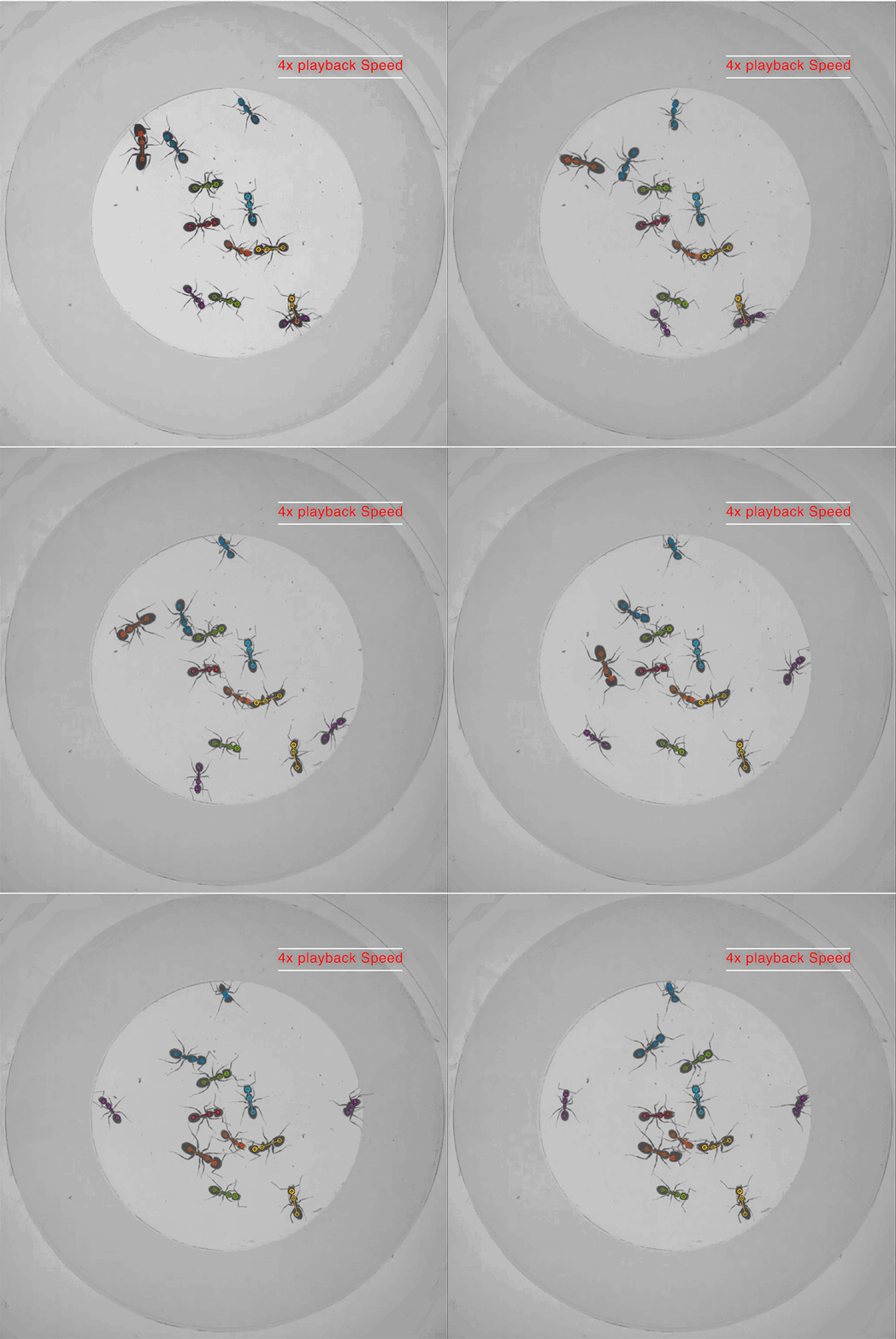
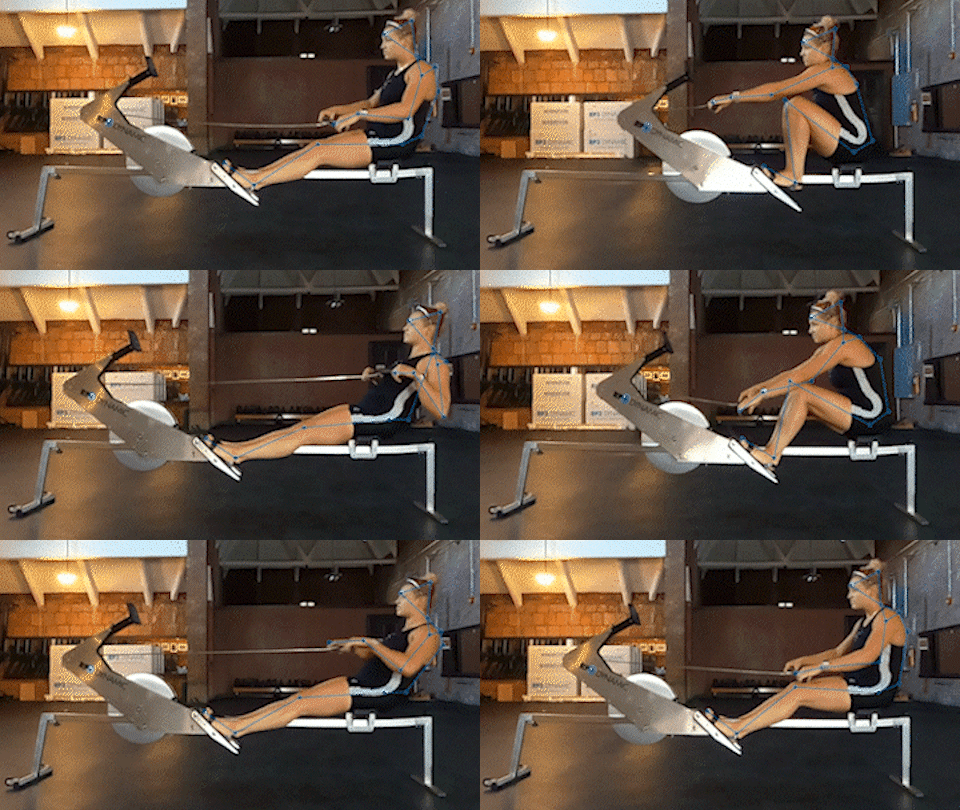
My career as an academic researcher spanned over 14 years, during which I focused on cognition, learning, memory, cooperation, and searching strategies in social animals, particularly social insects. Throughout my research, I blended classical behavioral science and ecology with cutting-edge computational tools, including computer vision, data science, and artificial intelligence. Please click here to check my academic publications.

Before joining LabXchange, I worked as a post-doctoral scientist at Harvard University from 2018 to 2023. There, I worked on deciphering navigational decision-making in ants with Venki Murthy and on cooperative behavior in ants and artificial agents with L. Mahadevan. A substantial focus of my research here was on creating tools to automate behavioral data collection from videos using computer vision and AI, supported by the Harvard Brain Science Initiative Pioneer Grant, given to scientists who take on "risky" pioneering projects, often involving developing new technologies. You can have a quick glimpse of my work in this article.

Before that, I worked as a visiting scientist with Martin Giurfa in Toulouse, France, exploring the neurobiology of collective behavior in honeybees. Before that, I obtained my PhD in Behavioral Sciences/ Behavioral Ecology from the Centre for Ecological Science at the Indian Institute of Science, under the guidance of Raghavendra Gadagkar.

At Harvard, I developed and have been teaching a course "Computational Behavioral Sciences" since 2020 (took a gap in 2023-2024). All the course material is free and open-source, and you can check it out here; check my GitHub page. I have also been involved in science communication and collaborated with Harvard Natural History Museum as an outreach scientist; here is a video produced by the museum explaining my work for non-experts. I have also taught Introductory Biology, Animal Behavior, Ecology, and Science communication at the undergraduate level.

Tracking_ant_collective_behavior Tracking_human_rowing_machine

DATA, TECH, & AI

Transitioning from Academia to Tech

Starting Off: My first brush with programming came around 2009-10, when I started wrangling and analyzing the data I collected for my PhD research. By the end of my PhD, I acquired handsome knowledge and skillsets on statistical modeling.

Diving Deeper: A big part of my post-doctoral work was very dependent on data automation and AI/ML workflows. Thanks to the supportive learning environment at Venki’s lab, this period was pivotal for me to gain expertise on DataOps and AI/ML on high-performance computing clusters, skills that are equally crucial in research and industry.

Teaching to Master It: Drawing inspiration from Richard Feynman, once I felt confident in my grasp of computer vision and AI/ML, I decided to deepen my understanding through teaching. In 2020, I developed and began teaching a course titled "Computational Ethology", which turned to "Computational Behavioral Sciences" in 2025. Teaching this course proved to be a dual learning journey—it not only refined my technical skills but also enhanced my capabilities in team management and educational delivery.

Moving Further: Curious about how the internet stitches together data and interfaces, I started learning about web data architectures, then progressed to big data, and gradually to data engineering. Each step was like a new door opening, broadening my understanding of the vast potential of data.

Generative AI – The Frontier: Since early 2023, I’ve been immersed in the intriguing world of Generative AI. This thrilling field is ripe with potential, poised to revolutionize our interactions with technology and how we harness its capabilities.

From my PhD days to now, every step has fueled my desire to harness technology for building a smarter and better-connected world. As we continue to expand our horizons, let's commit to forging pathways that promise a better world for all. Here's to the relentless pursuit of knowledge, innovation, and meaningful impact!